BITCOIN NODE - Transaction
- BITCOIN NODE - Transaction
BITCOIN NODE - Transaction
Why Transactions Are the Heart of Bitcoin
If Bitcoin were a living organism, transactions would be its heartbeat. Every action in the Bitcoin network—sending money, receiving money, mining rewards—is expressed as a transaction. Understanding transactions is fundamental to understanding Bitcoin itself.
What Makes Bitcoin Transactions Special?
- Immutable: Once confirmed in a block, transactions cannot be altered or reversed
- Transparent: Every transaction is visible on the blockchain for anyone to verify
- Scriptable: Transactions use a simple programming language (Bitcoin Script) to define spending conditions
- Efficient: VarInt encoding and UTXO model minimize blockchain size
- Secure: Double SHA-256 hashing ensures transaction integrity
The Flow of Value
┌─────────────┐
│  Previous   │
│ Transaction │ ────┐
│   Output    │     │
└─────────────┘     │
                    ▼
┌─────────────┐  ┌─────────────┐  ┌─────────────┐
│    Input    │  │    NEW      │  │   Output 0  │
│  (Unlocks   │──▶│ TRANSACTION │──▶│ (Locks to  │
│   UTXO)     │  │             │  │  Address A) │
└─────────────┘  └─────────────┘  └─────────────┘
                                  │   Output 1  │
                                  │ (Change to  │
                                  │  Sender)    │
                                  └─────────────┘
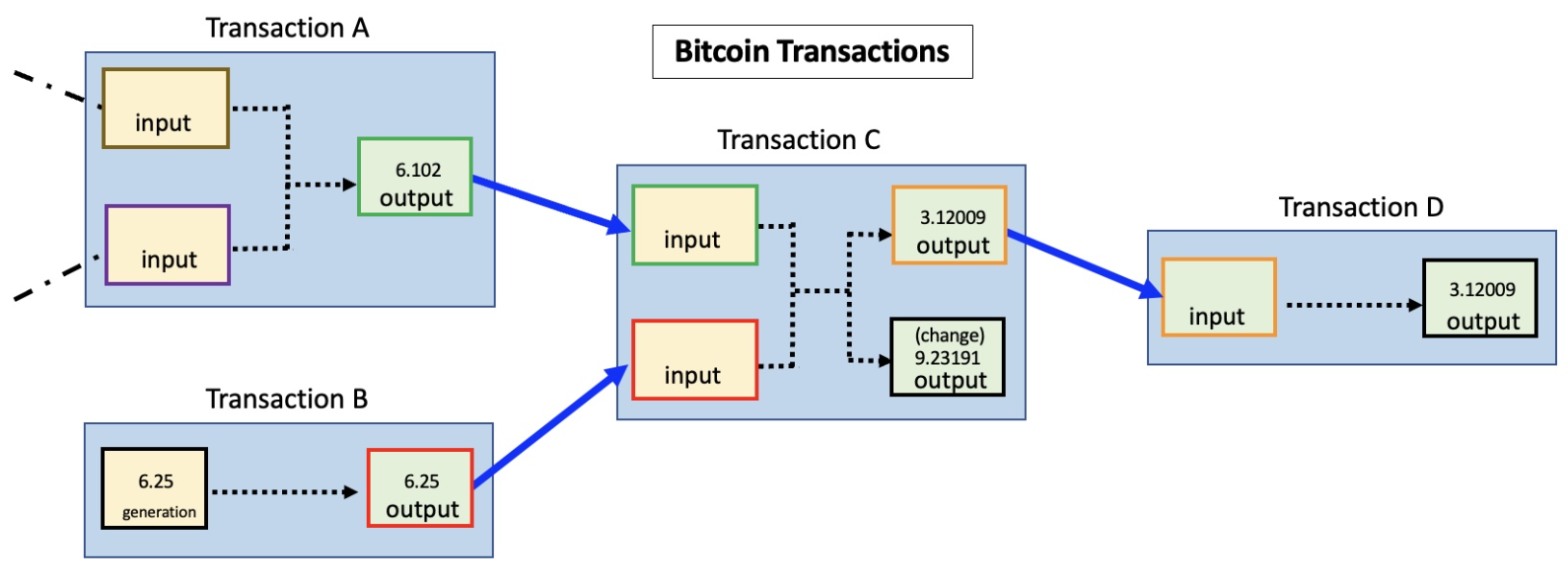
A transaction consumes previous outputs (inputs) and creates new outputs. This forms a chain of ownership that goes all the way back to coinbase transactions (newly created coins).
The UTXO Model
Bitcoin uses the UTXO (Unspent Transaction Output) model, which is fundamentally different from the account-based model used by traditional banking systems.
Account Model vs UTXO Model
Account Model (Banks, Ethereum):
Account Balance Ledger:
┌──────────────┬─────────┐
│   Account    │ Balance │
├──────────────┼─────────┤
│ Alice        │  $1,000 │
│ Bob          │    $500 │
│ Charlie      │  $2,000 │
└──────────────┴─────────┘

Transaction: Alice sends Bob $100
Result: Alice = $900, Bob = $600
UTXO Model (Bitcoin):
UTXO Set (Unspent Outputs):
┌──────────┬────────┬───────┬──────────┐
│   TXID   │ Output │ Value │  Owner   │
├──────────┼────────┼───────┼──────────┤
│ 4a5e1e.. │   0    │ 1 BTC │  Alice   │
│ 7b3c2a.. │   1    │ 2 BTC │  Bob     │
│ 9f8d5b.. │   2    │ 0.5   │  Charlie │
└──────────┴────────┴───────┴──────────┘

Transaction: Alice sends Bob 0.3 BTC

Input:  Consumes Alice's 1 BTC output
Output 0: Creates 0.3 BTC output for Bob
Output 1: Creates 0.7 BTC output for Alice (change)

New UTXO Set:
┌──────────┬────────┬───────┬──────────┐
│   TXID   │ Output │ Value │  Owner   │
├──────────┼────────┼───────┼──────────┤
│ new_tx.. │   0    │ 0.3   │  Bob     │  ← NEW
│ new_tx.. │   1    │ 0.7   │  Alice   │  ← NEW (change)
│ 7b3c2a.. │   1    │ 2 BTC │  Bob     │
│ 9f8d5b.. │   2    │ 0.5   │  Charlie │
└──────────┴────────┴───────┴──────────┘
Why UTXO?
- Parallel Validation: Different transactions spending different UTXOs can be validated in parallel
- Stateless Verification: You only need the referenced UTXO to verify a transaction, not the entire history
- Double-Spend Prevention: Once a UTXO is spent, it's removed from the set—no race conditions
- Privacy: Users can generate new addresses for each transaction
- Simplicity: Clear ownership chain—either a UTXO exists (unspent) or it doesn't (spent)
Transaction Structure
A Bitcoin transaction consists of four main components:
type Transaction struct {
    Version  int32      // Protocol version (usually 1 or 2)
    Inputs   []TxInput  // List of inputs (spending UTXOs)
    Outputs  []TxOutput // List of outputs (creating new UTXOs)
    LockTime uint32     // Earliest time/block for mining
}
Transaction Input (TxInput)
type TxInput struct {
    PreviousTxHash   [32]byte  // Which transaction?
    PreviousOutIndex uint32    // Which output of that transaction?
    ScriptSig        []byte    // Proof of ownership (signature + pubkey)
    Sequence         uint32    // Originally for RBF, now mostly 0xffffffff
}
Sequence 는 "초기에는 업데이트용으로 설계되었으나, 현재는 RBF(수수료 증액) 외에도 OP_CSV(상대적 시간 잠금) 를 구현하는 데 사용된다."
What an input does:
- Points to a previous output (UTXO) using
PreviousTxHash+PreviousOutIndex - Proves ownership by providing a signature (
ScriptSig) that satisfies the previous output's locking conditions
Special Case - Coinbase Input:
A coinbase input creates new bitcoins (block reward). It's identified by:
PreviousTxHash: All zeros (32 bytes of0x00)PreviousOutIndex:0xffffffff(maximum uint32 value)
Coinbase inputs don't spend existing UTXOs—they create new coins from thin air (within protocol limits).
func (in *TxInput) IsCoinbase() bool {
    // Check if previous tx hash is all zeros
    for _, b := range in.PreviousTxHash {
        if b != 0 {
            return false
        }
    }
    // Check if previous output index is 0xffffffff
    return in.PreviousOutIndex == 0xffffffff
}
Transaction Output (TxOutput)
type TxOutput struct {
    Value        int64  // Amount in satoshis (1 BTC = 100,000,000 satoshis)
    ScriptPubKey []byte // Locking script (defines spending conditions)
}
What an output does:
- Locks a specific amount of bitcoin (
Value) to a cryptographic condition - Defines who can spend it via
ScriptPubKey(typically "prove you own this public key")
Example Values:
50 BTC     = 5,000,000,000 satoshis (Genesis Block reward)
1 BTC      =   100,000,000 satoshis
0.01 BTC   =     1,000,000 satoshis
0.00000001 =             1 satoshi (smallest unit)
Binary Serialization Format
Bitcoin transactions are transmitted as binary data over the network:
┌─────────────────────────────────────────────────────────┐
│                    TRANSACTION BINARY FORMAT            │
├─────────────────────────────────────────────────────────┤
│ Version (4 bytes, int32, little-endian)                 │
├─────────────────────────────────────────────────────────┤
│ Input Count (VarInt)                                    │
├─────────────────────────────────────────────────────────┤
│ ┌─ For Each Input ─────────────────────────────────┐   │
│ │ Previous TX Hash (32 bytes)                      │   │
│ │ Previous Output Index (4 bytes, uint32, LE)      │   │
│ │ Script Length (VarInt)                           │   │
│ │ ScriptSig (variable bytes)                       │   │
│ │ Sequence (4 bytes, uint32, LE)                   │   │
│ └──────────────────────────────────────────────────┘   │
├─────────────────────────────────────────────────────────┤
│ Output Count (VarInt)                                   │
├─────────────────────────────────────────────────────────┤
│ ┌─ For Each Output ────────────────────────────────┐   │
│ │ Value (8 bytes, int64, little-endian)            │   │
│ │ Script Length (VarInt)                           │   │
│ │ ScriptPubKey (variable bytes)                    │   │
│ └──────────────────────────────────────────────────┘   │
├─────────────────────────────────────────────────────────┤
│ LockTime (4 bytes, uint32, little-endian)               │
└─────────────────────────────────────────────────────────┘
Why this format?
- Compact: VarInt encoding saves space for common small values
- Deterministic: Same transaction always serializes to same bytes
- Hashable: Serialized bytes can be hashed to compute TXID
- Network-efficient: Binary format is smaller than JSON/XML
TDD Implementation Process
Following the Red-Green-Refactor cycle, we implemented the transaction package with 97.7% test coverage.
Phase 1: RED - Write the Tests First
We started by writing tests with real Bitcoin data—the Genesis Block coinbase transaction:
func TestGenesisBlockCoinbase(t *testing.T) {
    // Genesis block coinbase transaction (raw hex)
    txHex := "01000000" +  // Version: 1
        "01" +             // Input count: 1
        // Coinbase Input
        "0000000000000000000000000000000000000000000000000000000000000000" +
        "ffffffff" +       // Coinbase markers
        "4d" +             // Script length: 77 bytes
        "04ffff001d0104455468652054696d65732030332f4a616e2f32303039..." +
        "ffffffff" +       // Sequence
        "01" +             // Output count: 1
        // Output
        "00f2052a01000000" +  // 50 BTC in satoshis
        "43" +                // Script length: 67 bytes
        "4104678afdb0fe5548271967f1a67130b7105cd6a828e03909a67962..." +
        "00000000"            // LockTime: 0

    txData, err := hex.DecodeString(txHex)
    require.NoError(t, err)

    // This will fail initially (RED phase)
    tx, err := Deserialize(bytes.NewReader(txData))
    require.NoError(t, err)

    // Verify the transaction
    assert.Equal(t, int32(1), tx.Version)
    assert.Len(t, tx.Inputs, 1)
    assert.True(t, tx.Inputs[0].IsCoinbase())
    assert.Len(t, tx.Outputs, 1)
    assert.Equal(t, int64(5000000000), tx.Outputs[0].Value)

    // Verify TXID
    expectedTXID := "4a5e1e4baab89f3a32518a88c31bc87f618f76673e2cc77ab2127b7afdeda33b"
    assert.Equal(t, expectedTXID, tx.TXID())
}
Why start with Genesis Block?
- It's the first Bitcoin transaction ever created by Satoshi Nakamoto
- It's immutable and well-documented
- If we can parse this correctly, our implementation matches Bitcoin's protocol exactly
Phase 2: GREEN - Make the Tests Pass
We implemented the structures and methods to make tests pass:
Step 1: Define the Structures
type TxInput struct {
    PreviousTxHash   [32]byte
    PreviousOutIndex uint32
    ScriptSig        []byte
    Sequence         uint32
}

type TxOutput struct {
    Value        int64
    ScriptPubKey []byte
}

type Transaction struct {
    Version  int32
    Inputs   []TxInput
    Outputs  []TxOutput
    LockTime uint32
}
Step 2: Implement Deserialization
func Deserialize(r io.Reader) (*Transaction, error) {
    tx := &Transaction{}

    // 1. Read version (4 bytes, little-endian)
    version, err := encoding.ReadInt32LE(r)
    if err != nil {
        return nil, fmt.Errorf("failed to read version: %w", err)
    }
    tx.Version = version

    // 2. Read input count (VarInt)
    inputCount, err := encoding.ReadVarInt(r)
    if err != nil {
        return nil, fmt.Errorf("failed to read input count: %w", err)
    }

    // 3. Read each input
    tx.Inputs = make([]TxInput, inputCount)
    for i := uint64(0); i < inputCount; i++ {
        input := &tx.Inputs[i]

        // Previous TX hash (32 bytes)
        if _, err := io.ReadFull(r, input.PreviousTxHash[:]); err != nil {
            return nil, fmt.Errorf("failed to read input %d prev hash: %w", i, err)
        }

        // Previous output index (4 bytes)
        prevIndex, err := encoding.ReadUint32LE(r)
        if err != nil {
            return nil, fmt.Errorf("failed to read input %d prev index: %w", i, err)
        }
        input.PreviousOutIndex = prevIndex

        // Script length (VarInt)
        scriptLen, err := encoding.ReadVarInt(r)
        if err != nil {
            return nil, fmt.Errorf("failed to read input %d script length: %w", i, err)
        }

        // ScriptSig
        input.ScriptSig = make([]byte, scriptLen)
        if _, err := io.ReadFull(r, input.ScriptSig); err != nil {
            return nil, fmt.Errorf("failed to read input %d script: %w", i, err)
        }

        // Sequence (4 bytes)
        sequence, err := encoding.ReadUint32LE(r)
        if err != nil {
            return nil, fmt.Errorf("failed to read input %d sequence: %w", i, err)
        }
        input.Sequence = sequence
    }

    // 4. Read output count and outputs (similar pattern)
    // 5. Read locktime
    // ... (see transaction.go for full implementation)

    return tx, nil
}
Key Implementation Details:
- Error Handling: Every read operation checks for errors
- VarInt Usage: Input/output counts and script lengths use VarInt encoding
- Little-Endian: All multi-byte integers use little-endian byte order
- Memory Safety: We allocate exact sizes for byte slices based on parsed lengths
Step 3: Implement Serialization
Serialization is the inverse of deserialization:
func (tx *Transaction) Serialize(w io.Writer) error {
    // 1. Write version
    if err := encoding.WriteInt32LE(w, tx.Version); err != nil {
        return fmt.Errorf("failed to write version: %w", err)
    }

    // 2. Write input count
    if err := encoding.WriteVarInt(w, uint64(len(tx.Inputs))); err != nil {
        return fmt.Errorf("failed to write input count: %w", err)
    }

    // 3. Write each input
    for i, input := range tx.Inputs {
        if _, err := w.Write(input.PreviousTxHash[:]); err != nil {
            return fmt.Errorf("failed to write input %d prev hash: %w", i, err)
        }
        // ... write other fields
    }

    // 4. Write outputs and locktime
    // ... (see transaction.go for full implementation)

    return nil
}
We verified round-trip serialization works correctly:
func TestTransactionSerialization(t *testing.T) {
    originalHex := "0100000001..." // Genesis transaction
    originalData, _ := hex.DecodeString(originalHex)

    // Deserialize
    tx, err := Deserialize(bytes.NewReader(originalData))
    require.NoError(t, err)

    // Serialize
    var buf bytes.Buffer
    err = tx.Serialize(&buf)
    require.NoError(t, err)

    // Compare: should be identical
    assert.Equal(t, originalData, buf.Bytes())
}
Step 4: Implement Transaction Hashing (TXID)
The Transaction ID (TXID) is computed by double SHA-256 hashing the serialized transaction:
func (tx *Transaction) Hash() []byte {
    var buf bytes.Buffer
    if err := tx.Serialize(&buf); err != nil {
        // In production, this should never happen for a valid transaction
        return make([]byte, 32)
    }

    return crypto.DoubleSHA256(buf.Bytes())
}

func (tx *Transaction) TXID() string {
    hash := tx.Hash()
    reversed := crypto.ReverseBytes(hash)
    return hex.EncodeToString(reversed)
}
Why reverse bytes for TXID?
Bitcoin internally uses little-endian byte order, but block explorers and user-facing tools display hashes in big-endian format (reversed) because it's more intuitive for humans to read.
Internal Hash (little-endian):
3ba3edfd7a7b12b27ac72c3e67768f617fc81bc3888a51323a9fb8aa4b1e5e4a

TXID (big-endian, for display):
4a5e1e4baab89f3a32518a88c31bc87f618f76673e2cc77ab2127b7afdeda33b
Phase 3: REFACTOR - Improve Code Quality
After tests passed, we added:
- Comprehensive Error Testing: Test every error path in serialization/deserialization
- Edge Cases: Empty transactions, multiple inputs/outputs, coinbase detection
- Documentation: Detailed comments explaining Bitcoin protocol specifics
- 97.7% Coverage: Ensured nearly all code paths are tested
func TestSerializeErrors(t *testing.T) {
    tx := &Transaction{ /* ... */ }

    tests := []struct {
        name      string
        failAfter int
    }{
        {"fail_at_version", 0},
        {"fail_at_input_count", 4},
        {"fail_at_input_prev_hash", 5},
        // ... test each serialization step
    }

    for _, tt := range tests {
        t.Run(tt.name, func(t *testing.T) {
            fw := &failWriter{failAfter: tt.failAfter}
            err := tx.Serialize(fw)
            assert.Error(t, err)
        })
    }
}
Genesis Block Coinbase Transaction
Let's dissect the very first Bitcoin transaction ever created:
Raw Transaction Hex
01000000 01 0000000000000000000000000000000000000000000000000000000000000000
ffffffff 4d 04ffff001d0104455468652054696d65732030332f4a616e2f32303039
204368616e63656c6c6f72206f6e206272696e6b206f66207365636f6e64206261
696c6f757420666f722062616e6b73 ffffffff 01 00f2052a01000000 43 410467
8afdb0fe5548271967f1a67130b7105cd6a828e03909a67962e0ea1f61deb649f6
bc3f4cef38c4f35504e51ec112de5c384df7ba0b8d578a4c702b6bf11d5fac
00000000
Breakdown
Version (4 bytes):
01000000 → 0x00000001 (little-endian) → Version 1
Input Count (VarInt):
01 → 1 input
Input (Coinbase):
Previous TX Hash (32 bytes):
0000000000000000000000000000000000000000000000000000000000000000
↑ All zeros = coinbase transaction

Previous Output Index (4 bytes):
ffffffff  →  0xffffffff  →  4,294,967,295 (max uint32)
↑ Special value for coinbase

Script Length (VarInt):
4d  →  77 bytes

ScriptSig (77 bytes):
04ffff001d0104455468652054696d65732030332f4a616e2f32303039204368616e
63656c6c6f72206f6e206272696e6b206f66207365636f6e64206261696c6f75742
0666f722062616e6b73

Decoded ASCII:
"The Times 03/Jan/2009 Chancellor on brink of second bailout for banks"
↑ Satoshi's famous message proving the block was created after this date

Sequence (4 bytes):
ffffffff  →  0xffffffff (final)
Output Count (VarInt):
01 → 1 output
Output:
Value (8 bytes, little-endian):
00f2052a01000000  →  0x000000012a05f200  →  5,000,000,000 satoshis  →  50 BTC

Script Length (VarInt):
43  →  67 bytes

ScriptPubKey (67 bytes):
04678afdb0fe5548271967f1a67130b7105cd6a828e03909a67962e0ea1f61deb6
49f6bc3f4cef38c4f35504e51ec112de5c384df7ba0b8d578a4c702b6bf11d5f ac

Format: <pubkey> OP_CHECKSIG
↑ Locks 50 BTC to Satoshi's public key
LockTime (4 bytes):
00000000 → 0 (no time lock)
TXID Calculation
- Serialize the transaction to bytes (hex above)
- Hash with DoubleSHA256:
Internal: 3ba3edfd7a7b12b27ac72c3e67768f617fc81bc3888a51323a9fb8aa4b1e5e4a - Reverse bytes for display:
TXID: 4a5e1e4baab89f3a32518a88c31bc87f618f76673e2cc77ab2127b7afdeda33b
You can verify this TXID on any block explorer:
- https://blockstream.info/tx/4a5e1e4baab89f3a32518a88c31bc87f618f76673e2cc77ab2127b7afdeda33b
Our test verifies this:
expectedTXID := "4a5e1e4baab89f3a32518a88c31bc87f618f76673e2cc77ab2127b7afdeda33b"
gotTXID := tx.TXID()
assert.Equal(t, expectedTXID, gotTXID)  // ✓ PASSES!
Serialization Format
Why Binary Serialization?
Bitcoin could have used JSON or XML for transactions, but binary serialization offers:
- Compactness: Binary is ~60% smaller than JSON
- Deterministic: Same data always produces same bytes (critical for hashing)
- Efficient Parsing: No need to parse text, convert strings to numbers, etc.
- Network Efficiency: Less bandwidth for P2P propagation
Size Comparison Example
JSON Format (hypothetical):
{
  "version": 1,
  "inputs": [{
    "prevTxHash": "0000000000000000000000000000000000000000000000000000000000000000",
    "prevOutIndex": 4294967295,
    "scriptSig": "04ffff001d0104...",
    "sequence": 4294967295
  }],
  "outputs": [{
    "value": 5000000000,
    "scriptPubKey": "04678afdb0fe5548..."
  }],
  "locktime": 0
}
Size: ~350 bytes (with formatting)
Binary Format:
01000000 01 000000...
Size: ~204 bytes
Savings: ~40% smaller!
VarInt Encoding in Transactions
VarInt is used for:
- Input count
- Output count
- Script lengths
Example from Genesis Transaction:
Input Count:  01           → 1 byte (value: 1)
Script Len:   4d           → 1 byte (value: 77)
Output Count: 01           → 1 byte (value: 1)
Script Len:   43           → 1 byte (value: 67)
If we had 1,000 inputs (rare but possible), VarInt encoding:
Input Count:  fd e803      → 3 bytes (value: 1000)
              ↑  ↑
              │  └─ 1000 in little-endian uint16
              └─ Prefix indicating 3-byte encoding
Fixed 8-byte encoding would use 8 bytes for every count, even for the number "1". VarInt saves significant space across millions of transactions.
Transaction ID (TXID) Calculation
The TXID uniquely identifies a transaction in the blockchain. It's computed as:
TXID = ReverseBytes(DoubleSHA256(SerializedTransaction))
Step-by-Step TXID Computation
Step 1: Serialize the Transaction
Convert the transaction structure to binary format:
var buf bytes.Buffer
tx.Serialize(&buf)
serialized := buf.Bytes()
Step 2: Double SHA-256 Hash
Apply SHA-256 twice:
firstHash := SHA256(serialized)
secondHash := SHA256(firstHash)
// secondHash is now the internal hash (little-endian)
Why double hashing?
- Defense against length extension attacks on SHA-256
- Additional security layer
- Historical design decision by Satoshi
Step 3: Reverse Bytes for Display
Bitcoin's internal representation uses little-endian, but users expect big-endian:
reversed := ReverseBytes(secondHash)
txid := hex.EncodeToString(reversed)
Example: Genesis Transaction
Serialized Bytes:
01000000010000000000000000000000000000000000000000000000000000000000000000
ffffffff4d04ffff001d0104455468652054696d65732030332f4a616e2f323030392043
68616e63656c6c6f72206f6e206272696e6b206f66207365636f6e64206261696c6f7574
20666f722062616e6b73ffffffff0100f2052a01000000434104678afdb0fe5548271967
f1a67130b7105cd6a828e03909a67962e0ea1f61deb649f6bc3f4cef38c4f35504e51ec1
12de5c384df7ba0b8d578a4c702b6bf11d5fac00000000

↓ First SHA-256
8b30c5ba100f6f2e5ad1e2a742e5020491240f8eb514fe97c713c31718ad7ecd

↓ Second SHA-256 (Internal Hash)
3ba3edfd7a7b12b27ac72c3e67768f617fc81bc3888a51323a9fb8aa4b1e5e4a

↓ Reverse Bytes (Display Format)
4a5e1e4baab89f3a32518a88c31bc87f618f76673e2cc77ab2127b7afdeda33b
                                                                    ↑
                                                            This is the TXID
Why Reverse?
Internal Format (little-endian):
3ba3edfd7a7b12b27ac72c3e67768f617fc81bc3888a51323a9fb8aa4b1e5e4a
└─┬─┘
  └─ Least significant bytes first (little-endian)
Display Format (big-endian):
4a5e1e4baab89f3a32518a88c31bc87f618f76673e2cc77ab2127b7afdeda33b
└─┬─┘
  └─ Most significant bytes first (big-endian, more intuitive for humans)
The TXID() method handles this automatically:
func (tx *Transaction) TXID() string {
    hash := tx.Hash()           // Internal format (little-endian)
    reversed := crypto.ReverseBytes(hash)  // Display format (big-endian)
    return hex.EncodeToString(reversed)
}
Test Coverage and Quality
We achieved 97.7% test coverage with comprehensive tests covering:
1. Happy Path Tests
Genesis Block Coinbase Parsing
func TestGenesisBlockCoinbase(t *testing.T) {
    // Parses the real Genesis Block coinbase transaction
    // Verifies version, inputs, outputs, TXID
}
Round-Trip Serialization
func TestTransactionSerialization(t *testing.T) {
    // Deserialize → Serialize → Compare
    // Ensures lossless conversion
}
Multiple Inputs/Outputs
func TestMultipleInputsOutputs(t *testing.T) {
    // Tests realistic transactions with 2 inputs, 3 outputs
    // Verifies all fields deserialize correctly
}
2. Error Path Tests
Serialization Errors
func TestSerializeErrors(t *testing.T) {
    // Tests 12 different failure points:
    // - Version write fails
    // - Input count write fails
    // - Each input field write fails
    // - Output count write fails
    // - Each output field write fails
    // - LockTime write fails
}
Deserialization Errors
func TestDeserializeIncompleteInput(t *testing.T) {
    // Tests 5 different incomplete input scenarios:
    // - Incomplete prev hash
    // - Incomplete prev index
    // - Incomplete script length
    // - Incomplete script
    // - Incomplete sequence
}

func TestDeserializeIncompleteOutput(t *testing.T) {
    // Tests 4 different incomplete output scenarios:
    // - Incomplete value
    // - Incomplete script length
    // - Incomplete script
    // - Incomplete locktime
}
3. Edge Cases
Empty Transaction
func TestEmptyTransaction(t *testing.T) {
    // Transaction with no inputs and no outputs
    // Should serialize and hash without error
}
Coinbase Detection
func TestTxInput(t *testing.T) {
    // Tests IsCoinbase() for both coinbase and normal inputs
}
4. Integration Tests
Transaction Hashing
func TestTransactionHash(t *testing.T) {
    // Verifies internal hash (little-endian)
    // Verifies TXID (big-endian, display format)
}
Coverage Report
btcnode/pkg/transaction/transaction.go:63:  IsCoinbase   100.0%
btcnode/pkg/transaction/transaction.go:167: Serialize     93.5%
btcnode/pkg/transaction/transaction.go:246: Deserialize   95.8%
btcnode/pkg/transaction/transaction.go:353: Hash         100.0%
btcnode/pkg/transaction/transaction.go:378: TXID         100.0%
────────────────────────────────────────────────────────────────
total:                                                    97.7%
What's not covered?
- A few unreachable error paths (e.g., Serialize failing on an empty transaction)
- Some defensive error handling that should never trigger in practice
97.7% coverage ensures:
- Every major code path is tested
- Error handling works correctly
- Integration with other packages (encoding, crypto) is verified
- Real Bitcoin data validates our implementation
Key Takeaways
1. Transactions Are State Transitions
Bitcoin doesn't have "accounts with balances"—it has a set of unspent outputs (UTXOs). Each transaction consumes some UTXOs (inputs) and creates new UTXOs (outputs). This forms an immutable chain of ownership.
2. Binary Encoding Matters
Bitcoin uses compact binary serialization with VarInt encoding to minimize blockchain size. This seemingly small optimization saves gigabytes of storage across millions of transactions.
3. Double Hashing for Security
Bitcoin applies SHA-256 twice (DoubleSHA256) to all critical data:
- Transaction IDs
- Block hashes
- Merkle tree nodes
This provides defense-in-depth against potential weaknesses in SHA-256.
4. Little-Endian Internally, Big-Endian for Display
Bitcoin's protocol uses little-endian byte order (x86 compatibility), but all user-facing tools reverse hashes to big-endian for intuitive reading.
5. TDD Ensures Correctness
By testing against real Bitcoin data (Genesis Block), we guarantee our implementation matches the protocol exactly. No guessing, no assumptions—just verified correctness.
Next Steps
Now that we have transaction serialization and deserialization working, we can build:
- Transaction Verification: Validate signatures, check input/output balances
- UTXO Set Management: Track unspent outputs
- Merkle Trees: Efficiently commit to transaction sets in blocks
- Block Parsing: Deserialize full Bitcoin blocks
- P2P Networking: Exchange transactions with other nodes
Every component builds on the transaction foundation we've established here.